International delegates re-elect Treasury Director from Kosovo as FreeBalance International Steering Committee (FISC)

February 1st, 2010

2010 FISC Elects Chair at Annual Meeting in Mont Tremblant, Canada

Ottawa, Canada (February  1, 2010) – FreeBalance, a For Profit Social Enterprise (FOPSE) software company that helps governments around the world to leverage robust Government Resource Planning (GRP) technology to accelerate country growth, today announced that Mr. Lulzim Ismajli, Treasury Director, Kosovo Ministry of Finance & Economy, has been re-elected as Chair of the FreeBalance International Steering Committee (FISC). Mr. Ismajli was elected by a group of senior government officials from Antigua & Barbuda, Kosovo, Mongolia, Pakistan, Palestine, Sierra Leone, and Timor-Leste as part of the annual FISC strategic planning sessions. 

The FISC provides an interactive forum to exchange public financial management good practices among international customers and Public Financial Management (PFM) thought leaders. FISC enables customer-centric development as it exposes the product roadmap providing traceability to specific customer requirements. FISC delegates set future direction by voting and prioritizing product specifications and enhancements. And, the FISC ensures proper oversight by voting one of their members as FISC Chair who serves for a one-year term. Previous FISC events were held in Prague, Czech Republic (2009), Cascais, Portugal (2008), and London, United Kingdom (2007). The FISC meets annually and through conference calls each quarter to adjust and modify the product road map. The FISC is a critical part of the global FreeBalance community. 

“To have been re-elected as Chair of the FreeBalance International Steering Committee is a great honour,” said Lulzim Ismajli, Treasury Director, Ministry of Finance & Economy, Government of Kosovo. “I look forward to working with such a distinguished group of international government officials as we leverage technology investments to accelerate economic development, improve accountability, transparency and modernization.” 

The 2010 FISC event was unique from previous years as it also included a program for Ministers and Partners. The Ministers Meetings provided participants with exclusive access to an interactive forum with influential PFM experts and speakers, including: Peter Hall, Vice President and Chief Economist of EDC; Jean-Louis Sarbib, CEO of Development Gateway; Michael Clarke, Director of the Information and Communication Technologies for Development at IDRC; Ken Cochrane, Managing Partner of SSG Southside Solutions Group and former CIO in the Government of Canada; Richard Worzel, Futurist; David Nummy, Executive Director of Grant Thornton; and Tom Helou, President & COO of Authenware. The FreeBalance Partners Program ran in parallel and provided participants with an interactive forum with the GRP community. 

“The annual FISC event aligns the FreeBalance vision with our customers’ needs and requirements and demonstrates our commitment that FreeBalance products and services are customer-centric and customer-driven,” said Manuel Pietra, President & CEO of FreeBalance. “FISC ensures our international customers achieve a sustainable Government Resource Planning solution with long-term capacity capabilities.”

FreeBalance customers span the globe and the user community includes public financial management professionals in 18 countries. FreeBalance operates in 15 customer time zones. FreeBalance has more than 60,000 users around the world. FreeBalance software manages a global civil service workforce of 1,500,000, and also manages a quarter trillion ($US) annual budgets worldwide.

It’s Time to Integrate Aid and Financial Management Systems

January 15th, 2010

aid_harmonizationAid Management software enables governments and development partners to collaborate. To harmonize aid. To meet development objectives.

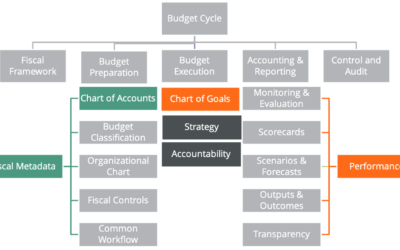
Government Resource Planning (GRP) software supports the entire budget cycle. GRP systems track government expenditures in support of objectives. These systems can also be used to manage donor funds provided to the government.  Donor projects and government expenditures are planned and executed in budgets. Budgets are forward-looking to enable multi-year planning and evaluation. Yet, these systems are rarely integrated despite the international effort through the Paris Declaration and the Accra Agenda for Action. It is time for action.

The lack of integration between aid and government financial management makes it difficult to monitor aid effectiveness. Some experts suggest that country systems should rarely be used – that a series of disjointed and disconnected systems can somehow improve development outcomes. Our view is that aid management is an integral part of GRP. And, we’re doing something about it.

FreeBalance and the Development Gateway Foundation

FreeBalance and the Development Gateway Foundation (DGF) have been partners since 2006. DGF is an international non-profit organization. We tested an integration between the DGF Aid Management Platform and FreeBalance Financials in 2006. We were able to transfer donor budget and disbursement information as budgets and allotments into FreeBalance Financials. And, we were able to transfer reporting information to AMP. Transaction costs are a significant concern in emerging economies. Governments require producing numerous project reports in different formats across different fiscal years in order to meet donor needs. This integration reduces these costs dramatically.  And, there are numerous benefits to integration in advancing aid harmonization and improving decision-making information.

We’re pleased that Jean-Louis Sarbib, the Chief Executive Officer of the Development Gateway Foundation, will be speaking to our customers at the upcoming FreeBalance International Steering Committee meeting.  We working on a joint white paper that describes the benefits and mechanisms for integration.

FreeBalance and the International Aid Transparency Initiative


COAThe International Aid Transparency Initiative(IATI), “aims to make information about aid spending easier to access, use and understand.” DGF is an active member of IATI. And, FreeBalance has been assisting in creating a standard for financial information exchange. The Government Chart of Accounts, including budget classifications, often includes all of the metadata necessary to communicate objectives, progress and results for aid management.

FreeBalance has implemented GRP systems in every World Bank region. At all tiers of government. From post-conflict to G7. We’ve shared classification methods used by our customers and how the COA was modernized over time. We’ve been able to analyze classification systems from other countries. The IATI team is hard at work analyzing these in detail.


Government Financial Management Sustainability a Developing Country Problem Too

January 15th, 2010

Sustainability is a key issue for Government Resource Planning (GRP) systems in emerging countries. That’s why we leverage the expertise of our customers at the FreeBalance International Steering Committee (FISC) to find better ways to reduce long-term costs. That’s why it is the dominant theme for our corporate blog. After all, what’s the use of a GRP if the government can’t afford to use it, maintain it and adapt it?

As we are gearing up for FISC 2010, we encountered a story in the local newspaper, the Ottawa Citizen: City taking a costly hit over lack of IT workers. It is reported that the City of Ottawa, Canada’s capital, is having difficulty attracting and retaining qualified information technology staff for their “financial, human-resources, inventory, fleet and maintenance” software.”  This software, from a well-known international vendor, not FreeBalance, was acquired as part a Y2K upgrade.

Many emerging nation governments acquire an Integrated Financial Management Information System (IFMIS) through a loan or grant. Proposals received are evaluated on a 5-year Total Cost of Ownership (TCO) basis. The government must fund the maintenance, upgrade and re-configuration funds to support the system after this 5 year period. (We’ve written about how to best evaluate TCO.)  By the end of 5 years, it is expected that the government is mostly self-sustaining: outside consultants or the software vendor is required for unusual circumstances.

10 Years After and Not Self-Sustaining

The City of Ottawaawarded C$1.7M in external consulting contracts in the summer of 2009. The average daily rate for specialists is C$1,200, according to the article.  We’ve learned, unofficially, that the implementation required approximately 2 years. (FreeBalance implementations, at the country level, average 9 months.)

Public servants who become experts in certain software packages can move to the private sector to increase salary. There is a disincentive for consultants to build capacity in the government.

Perhaps the City of Ottawa could learn more about capacity building from the Government of Afghanistan.

A Different Philosophy

As a For Profit Social Enterprise (FOPSE), our mission is to improve governance through the use of robust GRP software. It has become our ethical mission to make this software sustainable by governments. How?

  • Simplify the software so that it does not require foreign consultants to operate
  • Use configuration to simplify implementation and maintenance
  • Leverage progressive activation to enable governments to modernize without the high cost of customization
  • Involvement directly in the project with our partners to ensure knowledge transfer – including good practices in public financial management
  • Local and regional support so that costs are in line with local rates
  • FreeBalance International Steering Committee sessions on improving sustainability – not the traditional user group method
  • Customer portal and Customer Exchange to encourage knowledge sharing


Review: Shortcomings of Government Financial Management: A Generational Accounting Critique

January 14th, 2010

Paul J.M. Klumpesand Liyan Tang of Imperial College, London, have written an article on shortcomings of Government Financial Management in the recent Interational Journal on Governmental Financial Management published by ICGFM. The authors focus on under funding or the lack of effectively showing long-term government liabilities for liabilities like pensions, social security and health care. This is a topical subject given the efforts at reforming health care and pension plans around the world – from Argentina to the United States.

These liabilities span generations. Klumpes and Tang suggest that traditional government accounting methods do not value these commitments as obligations. In government accounting, these “obligations are only accountable if the service has already been provided.” Of course, many governments have not adopted accrual accounting or have adopted elements of accrual accounting.

There is clearly disconnection in incentives. Politicians tend to operate in the short term, from election to election. Considering long-term liabilities and other aspects of accrual accounting can present an accurate picture of the true financial state of any government. But, this transparency limits perceived bold moves by politicians.

The authors make a very convincing argument for governments to use a generational-based perspective rather than accrual. Many experts believe that full accrual accounting, as used in the private sector, is not appropriate for governments. Klumpes and Tang suggests that “accrual-based accounting estimates do not completely account for the financial imbalances because of the arbitrary truncation of the projection horizon.” They provide the argument for and against generational accounting and provide a framework that overcomes many of these issues.
Shortcomings of Government Financial Management a Generational Accounting Critique

Steering with Customers – FreeBalance International Steering Committee Starts Monday

January 14th, 2010

Doug Hadden

VP Products

Our annual FreeBalance International Steering Committee (FISC) meeting begins in Mont Tremblant on Monday. Let’s get one thing straight – this is a steering committee, not a user group! How does that differ?

User Group Steering Committee
Sales opportunity – “cross-sell”, “up-sell” Listening opportunity
Sales driven – salespeople with limited accessibility to executives Strategically driven – access to executives, salespeople kept back
Objective – to align customer budgets with software vendor products and services Objective – to align software vendor products and services to customer needs
Presentations, presentations and more presentations Interactive brainstorming, thought leader presentations, company presentations limited to new developments
Collect feature requests Collect long-term trends that enable anticipating future feature needs
Train customers to follow the software vendor process Learn how to adapt software vendor processes to meet customer needs
Star customers present successes to user group All customers present successes and challenges to the steering committee

This is our fourth annual FISC. Who would have thought in January 2007 that our 2 1/2 days with 7 repesentatives from 5 FreeBalance government customers, 1 guest speaker and 1 partner speaker would grow as it has? FISC 2010 is scheduled to have 6 Ministers and 16 additional representatives from 8 FreeBalance government customers. And, there are 9 guest speakers and 7 partner speakers arranged. Each FISC meeting has been more interactive than the last.  We look forward to posting some of the speaker presentations and lessons learned in Public Financial Management in the coming week.

2010 FreeBalance International Steering Committee (FISC) Drives Next Generation of Government Resource Planning (GRP) Solutions

January 14th, 2010

Global Public Financial Management community to gather in Canada this month for annual FreeBalance event

Ottawa, Canada (January 13, 2010) - FreeBalance, a For Profit Social Enterprise (FOPSE) software company that helps governments around the world to leverage robust Government Resource Planning (GRP) technology to accelerate country growth, today announced that the annual FreeBalance International Steering Committee (FISC) event will take place from January 18 – 21, 2010 in Mont Tremblant, Quebec. The FISC drives the FreeBalance Accountability Suite product vision to direct FreeBalance Government Resource Planning (GRP) solutions.

FreeBalance supports sustainable Public Financial Management (PFM). Every year the company brings together a select group of international customers for the FreeBalance International Steering Committee (FISC). The FISC provides an interactive forum to exchange public financial management good practices among international customers and PFM thought leaders. Previous FISC events were held in Prague, Czech Republic (2009), Cascais, Portugal (2008), and London, United Kingdom (2007).

“The annual FreeBalance International Steering Committee (FISC) event is critical for our sustainable customer-centric approach,” said Manuel Pietra, President & CEO at FreeBalance. “The FISC is designed to be a collaborative learning experience for both FreeBalance and its customers. The event provides an opportunity to build relationships and work towards mutual goals and objectives.”

The 2010 FISC event will include a unique program for Ministers. The Ministers Meetings will provide participants with exclusive access to an interactive forum with influential public financial management experts. Participating countries are actively undergoing significant PFM modernization and reform programs. Country growth, good practices and lessons learned in reform will be discussed in this intimate setting. Shared experiences will help leverage technology investments to accelerate development, improve accountability, transparency and modernization.

The FISC meets annually and through conference calls each quarter, and is an important part of the global FreeBalance community. FreeBalance customers span the globe and the user community includes public financial management professionals in 18 countries. FreeBalance operates in 15 customer time zones. FreeBalance has more than 60,000 users around the world. FreeBalance software manages a global civil service workforce of 1,500,000, and also manages a quarter trillion ($US) annual budgets worldwide. FISC helps ensure that the FreeBalance vision for Government Resource Planning (GRP) is aligned with government customer needs.

The 2010 FISC event also represents a new and unique opportunity for FreeBalance and its partners. As part of the recently launched FreeBalance Global Partner Program, partners are participating in FISC for the first time. The FreeBalance Partner Program event will run in parallel with the annual FreeBalance International Steering Committee (FISC) and the FreeBalance Ministers Meetings. The FISC 2010 Partner Program has been designed to provide participants with an interactive forum with the Government Resource Planning (GRP) community. The program will also enable FreeBalance and its partners to extend strategic relationships to more effectively support the global public financial management market.

Review: Using Periodic Audits to Prevent Catastrophic Project Failure

January 14th, 2010

Paul Dorsey of Dulcian has written a paper in the most recent International Journal on Governmental Financial Management published by ICGFM. Dr. Dorsey is well-known in ICGFM circles for fascinating observations from personal experiences. In this case, the value of IT audits despite significant costs.  He is quick to jump into very practical, rather than theortical matters: politics, project management and knowledge transfer.  And, the audit structure advocated in the paper is comprehensive.

Dr. Dorsey believes that custom developing government Integrated Financial Management Information Systems is preferable to customizing a generic ERP system. He asserts that “COTS projects fail with the same regularity as custom development projects.”  There are advantages and disadvantages to either approach as we have pointed out in the past. Our view is that Government Resource Planning (GRP) systems – designed for governments –  is the preferable option.  This has resulted in more on-time, on-budget and sustainable implementations than alternatives. The FreeBalance Accountability Suite is Commercial Off-The-Shelf (COTS) but does not require much, if any customization. Dr. Dorsey suggests that “COTS projects have enough customization that they need the same level of scrutiny as a custom development project.” IT audits are recommended regardless of the level of cusomization. The audit can identify configuration issues in the GRP. And, the GRP sits on a technology stack of middleware and networks and databases.  He suggests that “only 30% of systems typically receive a review”, according to a 2007 ICGFM survey.

There are 4 case studies presented in the paper from Ethiopia, Tanzania and two “anonymous” countries. It is interesting how the audit results presented by Dr. Dorsey for Ethiopia and Tanzania do not match the general perception in the wider PFM community. This suggests that more work is needed to formalize IT audit standards, perhaps providing an IT audit framework similar to Public Expenditure and Financial Accountability (PEFA).

Using Periodic Audits to Prevent Catastrophic Project Failure

Review: IMF Publishes Budget Classification Technical Note

January 14th, 2010

The International Monetary Fund has published a new Technical Note about Budget Classifications. The IMF has been advancing the sharing of PFM knowledge with a number of recent notes that we’ve commented on including:

The Budget Classification Technical Note was authored by Davina Jacobs, Jean-Luc Hélis, and Dominique Bouley of the IMF Fiscal Affairs Department. This technical note provides a good case for the importance of budget classifications. It provides some good high-level technical advice in designing budget classifications. Some of the assertions, though, do not appear to follow standard practice. Sequencing PFM reform is considered a good practice. This technical note generally supports this approach. But, the implied sequence does not appear to follow the typical pattern.  We agree that the budget classification is ”one of the fundamental building blocks of a sound budget management system.” Perhaps even the most important building block – we often say that all government financial management begins with the Chart of Accounts. (In our world, the COA includes budget classifications.) The budget classification enables controlling government finances, following the budget law.

Issues to consider:

  1. “Separate presentation in the accounting classification to ensure the proper recording of budgetary transactions” does not seem to follow typical practices. The (COA) Chart of Accounts should include all budget and accounting classifications. That does not mean that accounting data entry is more complex in automated systems. And, budget preparation and execution can be managed by filtering out any unnecessary accounting details.
  2. “Once established on a sound basis, a classification scheme should not be substantially changed unless there are strong reasons; a stable classification facilitates both the analysis of trends in fiscal policy over time and intercountry comparisons.” This is an interesting ideal. In practice, governments adapt the classification scheme to improve outcomes. And, as indicated in Section VII, governments are constantly reforming. So, an ideal budget classification for any government, should it exist, often requires time to implement because of legal reform. And, there is no reason why changing details in the classifications can inhibit intercountry comparisons. Like with GFS, the intercountry comparisons can roll-up from the detailed COA. And, financial systems with multi-year Charts of Accounts enable comparisons such as viewing the 2007 fiscal year based on the 2010 fiscal year classifications.
  3. The technical note recommends that 3 mutually exclusive classifications, administrative, economic, and functional should be used. These would represent segments within the COA. (Of course, the standard accounting or object segment is needed to support accounting functions.) The note suggests that financing source should be considered as an additional classification. This does not seem to be wise for emerging countries that have a high percentage of Official Development Assistance. The use of a financing source segment enables governments to track donor conditions. This makes it more likely that governments, rather than 3rd parties, will be entrusted in executing donor funds. This reduces transaction costs.
  4.  The addition of a program segment is typically sequenced later. The example provided shows how the addition of the program concept can extend the administrative segment. This approach is effective only when administrative units own programs. This is sometimes not the case. Expenditures can be controlled when there is a separate segment for program and administration. Automated financial systems support valid code combinations so that the 1 to 1 or 1 to many association between program and administration can be modeled and controlled. We have found a higher likelihood that functional and program classifications share the same segment.

FreeBalance 2009 Support Ends on a Low Note

January 5th, 2010

Support Cases fall by 2/3

We’ve been writing about our methodology to improve customer support for some time. Our focus has been to reduce the number of open cases and the number of emergency open cases. The result? Reduction of open cases by 66% since March 2008. Reduction of open emergency cases (average for Q4′2009) compared to March 2008 of over 95%.

Our goal is to ensure that FreeBalance implementations remain the most sustainability GRP (Government Resource Planning) around the globe. Customer support is an essential ingredient to enable sustainable public financial management.

Our focus in 2010 is to reduce the case load per customer. We have no customers assessed as red (more than 25 cases) and 3 customers assessed as yellow (more than 10 cases). We look forward the end of 2010 when we hope to reach new lows!

IMF Posts Paper: Fiscal Rules-Anchoring Expectations for Sustainable Public Finances

December 23rd, 2009

Yesterday, the IMF made available the Fiscal Rules-Anchoring Expectations for Sustainable Public Finances paper that describes the usefulness of fiscal rules in supporting fiscal consolidation and discusses the fiscal frameworks that could be adopted as countries emerge from the current worldwide economic crisis. Published on Dec 16, 2009, this paper was requested by the G-20 and the IMFC and represents the IMF’s ongoing analytical research on economic strategies to be adopted after the crisis.

The paper addresses how in many cases the current global crisis has strained the rules and presents the case that in order to move forward beyond the current economic crisis, that rules-based frameworks can be useful in anchoring expectations regarding fiscal sustainability.

The authors of the paper agreed that rules based frameworks could play an important role in enhancing confidence and anchor expectations regarding fiscal sustainability. And that it was is essential for these frameworks to be tailored to countries’ circumstances.

Read the staff paper on the IMF’s website >>